
Conventional wisdom suggests that "housing and retail share the same roots"—implying that if the residential market prospers, non-residential sectors will naturally follow. However, since the total withdrawal of "spicy measures" (demand-side management measures) in 2024, the ecosystem of Hong Kong’s residential and retail sectors has undergone a seismic shift. Between buying a home and investing in a retail shop, which is the safer bet today? We analyze the data from the 1997 peak through 2025 to break down the ten core differences.
I. Historical Comparison: The 1997 Peak
Looking back at 1997, the most frenetic period in Hong Kong’s real estate history: 1997 年 香港地產最瘋狂的時期:
- Transaction Volume: Residential properties recorded 178,000 registrations, while retail shops saw only 5,798. The residential volume was 29.7 times that of retail. 29.7 倍.
- Transaction Value: Total residential turnover reached HK$695.6 billion, compared to HK$75.9 billion for retail. Residential capital flow was 8.2 times higher. 8.2 倍.
- Average Unit Price: At the time, the average price per home was HK$3.9 million, while the average shop cost HK$13.09 million..
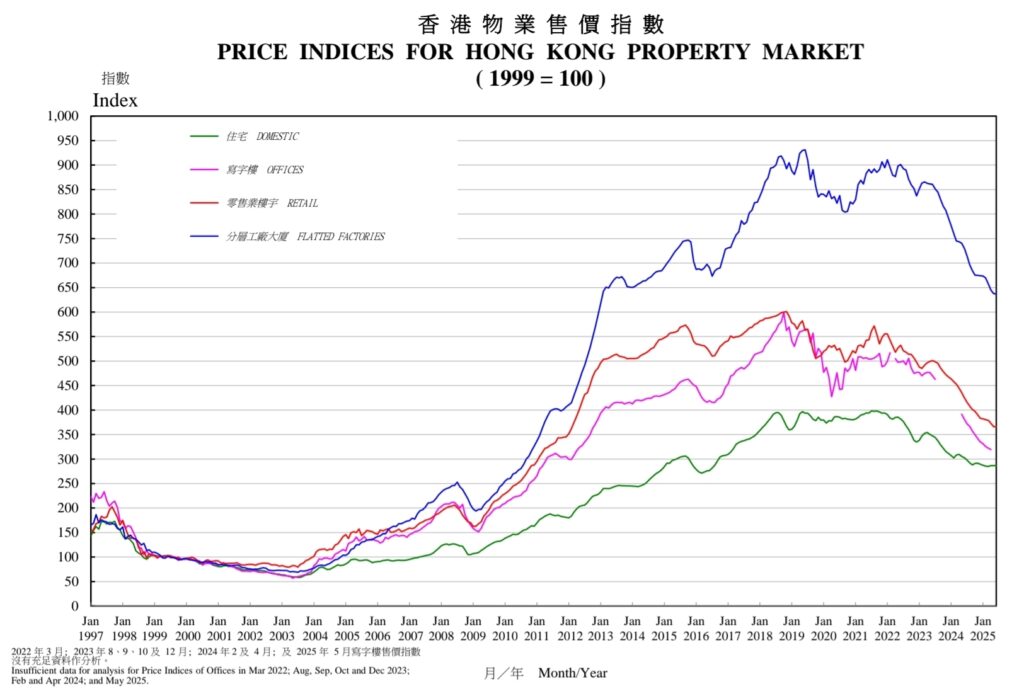
II. The Decade in Review: Data Evolution (2016–2025)
A look at the 10-year average reveals a widening gap between the two sectors:
- Market Liquidity: Residential transactions averaged 62,000 annually, while retail shops averaged only 1,309. In terms of volume, the residential market is now 46 times more active than retail.
- Capital Scale: Capital Scale: Residential turnover averaged HK$524.6 billion per year, while retail stood at HK$26.3 billion. Residential capital scale is 19 times that of retail..
- Price Migration: Over the past decade, the average home price rose to HK$8.46 million, while the average shop price climbed to HK$20.09 million..
III. 2025 Post-DSD Era: The Residential Buying Frenzy
On February 28, 2024, the Financial Secretary announced the total withdrawal of all property cooling measures. This had a profound impact on 2025 data:
- The Volume Gap: Residential registrations surged to 70,459 units (HK$544 billion), while retail shops remained stagnant at **1,089** units (HK$15.4 billion).
- The Multiple: Post-withdrawal, residential transactions were 64 timeshigher in volume and 34 times higher in value than retail!
Observation: Twelve years of pent-up residential purchasing power flooded the market after the "de-spicing," pushing the transaction gap between retail and residential to a historical high.
IV. Success Rate: Ease of Exit
According to the Housing Bureau’s "Housing Statistics 2025" and Midproperty estimates:
- Residential: There are approximately 3.05 million units in HK. With 70,000 transactions per year,roughly 1 out of every 43 units is successfully sold.
- Retail Shops: There are roughly 100,000 street-level shops (excluding internal transfers and shopping mall units). Based on annual volume,only 1 out of every 300 shops is successfully sold.
V. Price Convergence: Is Retail Losing Its Premium?
While the average price per unit for retail remains higher than residential,the premium is narrowing significantly:
- 1997: Shops were 2.4 times more expensive than homes.
- 2025: Shops are only 83% more expensive than homes. 83%.
This reflects the challenges facing retail valuations due to the "Northbound Consumption" trend (cross-border shopping in Shenzhen), e-commerce disruption, and changing tourism patterns. Conversely, residential properties remain resilient, bolstered by new talent schemes (TTPS) and interest rate cuts.
Conclusion: Does a Stable Housing Market Guarantee Retail Growth?
History proves that residential property is the lifeblood of Hong Kong’s economy. Once home prices stabilize, the non-residential sectors usually follow suit, albeit with a significant time lag.
Key Factors to Watch:
If residential prices rise too sharply post-withdrawal, leading to social pressure, will the government reintroduce "spicy measures"? If so, capital may once again flow back into the commercial and retail markets. Currently, residential property is outperforming the market due to end-user demand and policy dividends. The long-term value of retail, however, will depend on the successful structural transformation of Hong Kong’s retail industry.

 English
  繁中
繁中  简中
简中